Over 50,000 Square Feet in Two Fantastic Antique Showrooms: Baton Rouge, and Dallas!
Glossary of Antique Terms
A
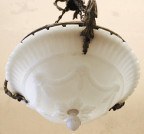 Alabaster
A fine-grained, semi-translucent form of crystalline gypsum, usually off-white in color
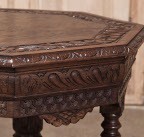 Apron
Apron
Decorative wood crosspiece found at the bottom of a table, drawer or the end of a piece of furniture that is usually shapely and decorative
 Armoire
A wardrobe or cupboard with at least one full-length door
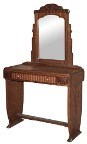 Art Deco
A decorative style of the 1920s and 1930s featuring bold, precise geometric shapes and strong colors
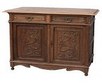 Art Nouveau
A style of decorative art, architecture, and design prominent in Western Europe and the USA from about 1890 until World War I and characterized by intricate linear designs and flowing curves based on natural forms
B
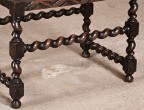 Barley Twist
The spiral effect, resembling screw threads, on a piece of furniture that is usually found on the leg of table or desk but also as a columnar architectural accent on the facade
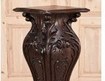 Baroque
A style that originated in Italy and was later refined during the reign of Louis XIV in France, commonly equated with naturalistic form combined with a complex opulence with influences rooted in classic architecture and design
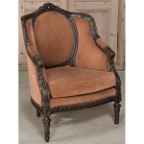 Bergere
An upholstered or caned armchair with closed sides
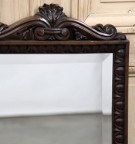 Bevel
Bevel
A slope from the horizontal or vertical in glasswork and stonework (see chamfer)
 Bibliotheque
An armoire or cabinet with shelves designed to be used as a bookcase
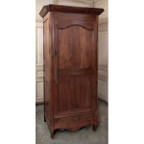 Bonnetiere
A small armoire originally used to store women’s bonnets (see homme debout)
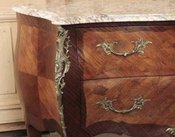 Bronze dore
Cast bronze used for furniture ornamentation and clock production that has been layered or plated with gold (see ormolu)
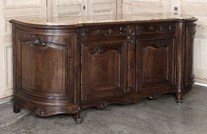 Buffet
French word for cupboard or sideboard with one or more doors or drawers, an adaptation of the coffre (trunk) with legs to raise it up to provide a serving surface
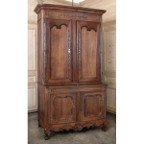 Buffet a deux corps
A cupboard or sideboard with two distinct cabinet areas, the bottom being equivalent to a buffet and the top frequently fitted with shelves and many times with glass doors for dishes and fine china (see china buffet)
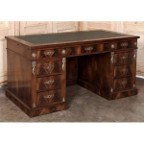 Bureau
French for writing table or desk (also office)
C
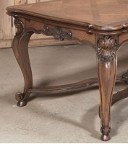 Cabriole leg
An “S” curved leg with tapered form, frequently carved on the shoulder above and the foot below
 Cache pot
Ornamental holder for potpourri or aromatic infusion, also suitable as a flower pot (see jardinière)
 Canapé
French word for settee or a sofa that seats around two people, usually caned or upholstered with open arms
 Candelabra
Large candlestick with arms or holders for several candles or light bulbs
 Case piece
Furniture, usually large in size, that provides interior space for storage.
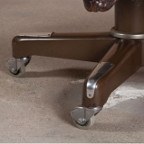 Casters
Wheels on the bottom of furniture pieces that allow them to be easily moved across the floor.
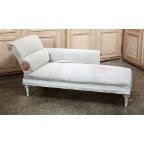 Chaise lounge
A long chair-form seat or daybed
 Chamfer
A slope from the horizontal or vertical in woodwork (see bevel)
 Chinoiserie
French name for furniture or decorative items that have Chinese origin or style
 Commode
French chest of drawers, sometimes with drawers concealed by cabinet doors
 Confit Pot
Glazed green or yellow earthenware pot originally used to store goose meat in fat or jam but is commonly used as a decorative pot or flower pot now
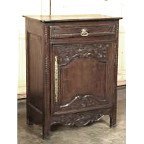 Confiturier
Small buffet, usually with one door and sometimes a drawer originally intended to hold confit pots
 Console
A table with as few as one leg and as many as six legs that is either self-supported and placed against the wall or uses wall brackets to support itself against the wall. Originally an architectural extension of the window sill.
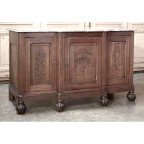 Credenza
A buffet or side cabinet used in the office or as an alternative to the console, usually containing cabinets and/or drawers
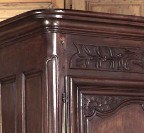 Crown molding
Elegant top molding
D
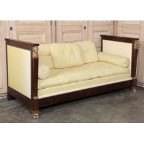 Day Bed
An upholstered couch or canapé that can serve as a bed during the evening hours
 Directoire
Neoclassical decorative style intermediate between the more ornate Louis XVI style and the Empire style, prevalent during the French Directoire (1795–99)
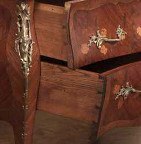 Dovetail
Type of carpentry joint where adjoining boards are fastened by interlocking fan-shaped cutouts
 Dowel
Dowel
Cylindrical peg of wood, metal, or plastic used for holding together components of a structure
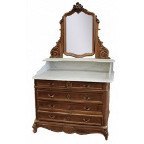 Dresser
Chest of drawers or commode with an attached mirror, usually with a marble surface
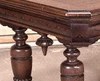 Drop-finial
Hanging architectural element that was sometimes used on 17th-century furniture such as tables and court cupboards, also called a pendant finial
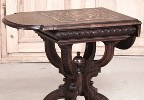 Drop leaf
A table leaf hinged parallel to the table top that can be raised and supported by brackets or swing-out legs as needed
E
 Embossing
Three-dimensional engraving in leather, wood or plaster
 Empire
Early 19th-century design movement in architecture, furniture, other decorative arts originally propounded by Napoleon and Josephine & influenced by the ancient architecture of Egypt, Greece & Rome
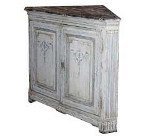 Encoignure
Small armoire, commode, cabinet or cupboard made to fit a corner
 Engraving
Print made from an engraved plate, block, or other surface
F
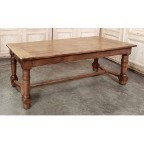 Farm table
A country table, usually rectangular, with no drop leaves
 Fauteuil
French word for armchair with open space between the arm and seat
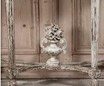 Finial
Ornament at the top, end, or corner of an object
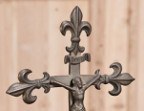 Fleur-de-lis (also fleur de lys)
Stylized lily composed of three petals bound together near their bases. It is especially known from the former royal arms of France but originated in Florence, Italy
 Fluting
Shallow grooves running along a surface
 French Provincial
Also known as Country French, the style that originated in the somewhat rural provinces of France, with those from Provence itself correctly referred to as “Provencal”
G
 Gilding
Applying fine gold leaf or powder to solid surfaces such as wood, stone, or metal to give a thin coating of gold
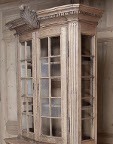 Glazing
Glass, either plate or hand-rolled. Can be silvered to create a mirror
 Gothic
Relating to an architectural style derived from medieval style of architecture that flourished during the high and late medieval period
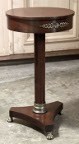 Guéridon
A small round table
H
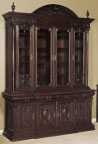 Henri II
Artistic movement of the sixteenth century in France, part of Northern Mannerism. It came immediately after the High Renaissance and was largely the product of Italian influences; revived during the second half of the 19th century
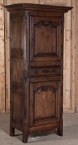 Homme Debout
A derivation of the small armoire adapted for masculine use, usually characterized by an upper and lower cabinet separated by a drawer (see bonnetiere)
I
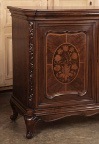 Inlay
Inlay
Decoration made by fitting pieces of wood into prepared slots in a surface
 Intaglio
Carved decoration that is inset into the wood’s surface, rather than revealed above it as in bas relief or relief carving
J
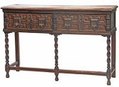 Jacobean
Style prevalent during the reign of James I, also referring to a particularly dark stain color used on oak
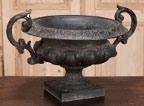 Jardiniere
A decorative pot or stand designed to hold floral displays, many times made from metal but sometimes from carved wood or ceramics (see cache pot)
K
L
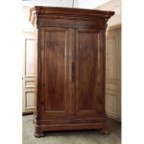 Louis-Philippe
Louis Philippe (1773 – 1850) was King of the French from 1830 to 1848 in what was known as the July Monarchy. He was the last king to rule France, although Napoleon III would serve as its last monarch. The style of furniture that came into favor during his reign was very austere of line and mostly devoid of carved or bronze ornamentation
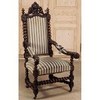 Louis XIII
Louis XIII (1601–1643) was a Bourbon monarch who ruled as King of France and of Navarre from 1610 to 1643. The style associated with his reign represents a transition from the Gothic to the Renaissance
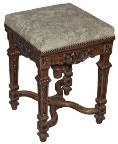 Louis XIV
Louis XIV (1638–1715), known as the Sun King, was a Bourbon monarch who ruled as King of France and Navarre. He holds the distinction of being the longest-reigning king in European history, reigning for 72 years and 110 days from 1643 to 1715. During his reign the baroque style reached its peak resulting in opulence such as Versailles
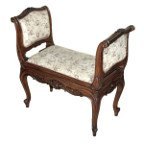 Louis XV
Louis XV (1710–1774) was a Bourbon monarch who ruled as King of France and of Navarre from 1715-1774. The style adopted during his reign was a delicate interpretation of the Italian baroque with emphasis on shell motifs, hence the moniker rococo from the French rocaille. (see rococo)
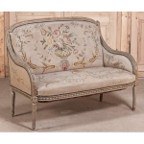 Louis XVI
Louis XVI (1754-1793) was a Bourbon monarch who ruled as King of France and Navarre until 1791, and then as King of the French from 1791 to 1792. During his reign the classic style from ancient Greece and Rome was revitalized and interpreted by the French in a wide variety of iterations
M
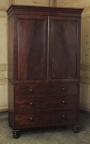 Mahogany
A rain-forest wood of straight grain and highly desirable qualities of workability, durability and finish acceptance, imported to Europe in great quantities since the 18th century for furniture production
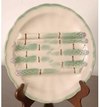 Majolica
Highly decorated earthenware with a glaze primarily of tin oxide
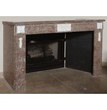 Mantel
Shelf and supports that project from the wall surrounding a fireplace
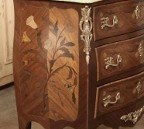 Marquetry
Wooden inlays of patterned designs such as curved lines or floral carvings utilizing different species of wood to create contrast and an artistic effect
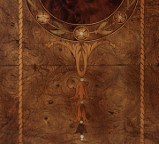 Mother-of-Pearl
Iridescent internal layer of a mollusk shell used to line small vessels or to decorate the exterior of finely crafted furniture
N
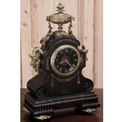 Napoleon III
Louis-Napoleon Bonaparte (1808 – 1873) was the President of the French Second Republic and as Napoleon III, the emperor of the Second French Empire (1852-1870). During his reign all of the past great French styles were revived during what many consider the golden years for French furniture manufacturing. His empress Eugenie also helped create a style named after the emperor that was a blend of the Henri II and Louis XVI styles.
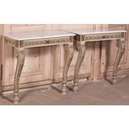 Neo-classical
Style that coincided with the 18th century Age of Enlightenment, and continued into the present that is based upon ancient Greek, Roman and to a small degree, Egyptian architecture and style, also known as Louis XVI style
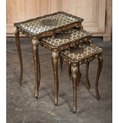 Nesting Tables
A set of tables of various sizes, typically stored by “nesting” the smaller tables within the legs of the larger.
O
 Oak
Oak
An indigenous European wood frequently used for entire furniture in the northern latitudes and as a base & case wood behind more exotic indigenous and imported woods from more southern latitudes.
Ormolu
Gold-colored bronze, cast into desired shapes and often gilded (see bronze dore), used especially in the 18th century for decorating furniture and making ornamentation
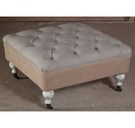 Ottoman
A low upholstered and padded seat, or footstool, without a back or arms that can sometimes serve as a box, with the seat hinged to form a lid
P
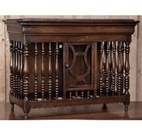 Panetière
Originating in Provence, a large, usually finely carved bread box with intricate turned spindles and resembling a birdcage
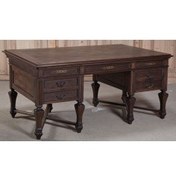 Partner's desk
An antique desk form designed for two users working while facing each other
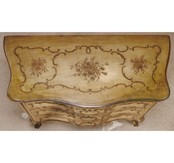 Patina
A gloss or sheen on wooden antique furniture or antique metal objects resulting from the aging process combined with polishing and waxing
 Period
Describes something created at the time its style first originated
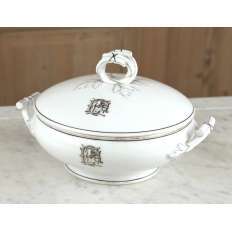 Porcelain
White vitrified translucent ceramic
Q
R
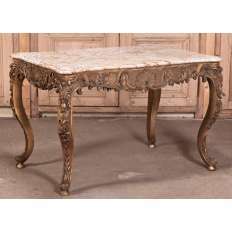 Regence
The period between the reign of Louis XIV and his grandson, Louis XV during which a regency was in power, hand-picked by Louis XIV to rule during his grandson’s ascendancy. The style attributed to this period is a blend of the baroque and rococo styles
 Regency
Denoting British architecture, clothing, and furniture of the Regency or, more widely, of the late 18th and early 19th centuries
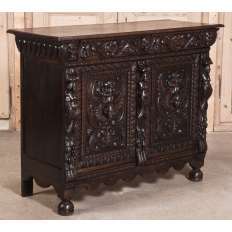 Renaissance
Revival of art and literature under the influence of classical models in the 15th-16th centuries
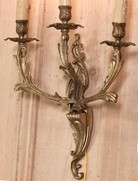 Rococo
Characterized by an elaborately ornamental late baroque style of decoration prevalent in 18th-century Continental Europe, with asymmetrical, naturalistic patterns involving shell, foliate & floral motifs and scrollwork (see Louis XV)
S
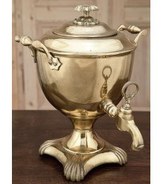 Samovar
Decorative tea serving urn originating from Russia
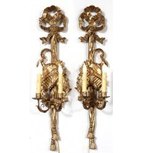 Sconce
Candle holder, or a holder of another light source, that is attached to a wall with an ornamental bracket, also refers to a wall bracket serving as a miniature console.
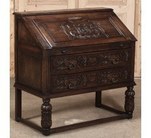 Secretaire
Desk with a drop-front panel that creates a writing surface when open, usually concealing drawers; in English~ secretary
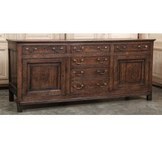 Sideboard
A flat-topped piece of furniture with cupboards and drawers, placed along a wall and primarily used for serving and storing dishes, glasses, and table linens (see buffet)
T
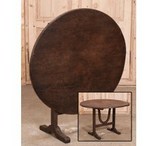 Tilt-top Table
Pedestal table whose top is hinged so that it can be tilted to a vertical position
 Trompe l’oeil
French for “deceive the eye”, an art technique involving extremely realistic imagery in order to create the optical illusion that the depicted objects exist in three dimensions
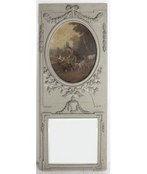 Trumeau
A mirror with an ornamental panel typically displaying a painting or carvings above or below the glass mirror
U
V
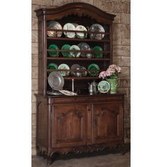 Vaisselier
French buffet with open shelving on top used for displaying dishes and china
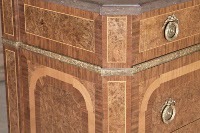 Veneer
A thin decorative covering of fine wood applied to a coarser base wood or other material
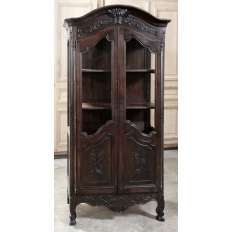 Vitrine
A glass-paneled display cabinet or case primarily used to display china or collectibles also called a curio cabinet
W
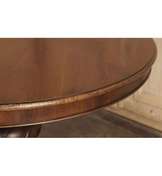 Walnut
A buttery brown decorative hardwood primarily from Europe, with French walnut considered the premier variety
X
Y
Z
About Us
Since 1991, Inessa Stewart's Antiques is Your Best Source for French, Italian and European Antique Furniture, Antique Paintings, Antique Lighting, Antique Decorative Accessories & More!